Kalshi Addiction: How to Stop Betting on Kalshi and Polymarket
Need help now? US: call or text the National Problem Gambling Helpline at 1-800-MY-RESET (1-800-697-3738). UK: GamCare 0808 8020 133. Free, confidential, 24/7. If you're thinking about harming yourself, call or text 988 (US) or call Samaritans on 116 123 (UK).
Kalshi addiction, in short
Kalshi addiction is real, and so is the Polymarket version. The apps call it trading, but buying a yes-or-no contract on a game or a Bitcoin price works a lot like placing a bet. The National Council on Problem Gambling calls it "functionally gambling." If you banned yourself from sportsbooks, that ban almost certainly doesn't reach these platforms.
To stop: close your positions and self-exclude on Kalshi, add a SelfExclude.io exclusion, exclude yourself on Polymarket, delete the apps and block the sites, cut the money route, and tell one person (jump to the steps). It's one part of the bigger how to stop gambling plan.
Is Kalshi gambling? What a prediction market actually is
Kalshi and Polymarket are prediction markets. You buy a contract that asks a yes-or-no question about an event: an election, a game, the price of Bitcoin, tomorrow's weather. If the event happens, a "yes" contract pays a fixed amount. If it doesn't, it pays nothing. Prices move as people buy and sell, so you can also sell before the result comes in.
In the US, these platforms are regulated by the Commodity Futures Trading Commission (CFTC) as exchanges, called designated contract markets (CFTC, March 2026; Polymarket US). Polymarket runs its US platform at polymarket.us, separate from its international site. Kalshi says state gambling rules don't apply to it, and it isn't licensed as a gambling business by the states (NPR, October 2026). A coalition of 44 states argues in court that these platforms should be regulated like gambling (CNN). Federal appeals courts have split: one sided with Kalshi in April 2026, and two sided with states in August and September (CNBC). New Jersey has asked the Supreme Court to take the case, and the court's docket shows no decision yet on whether it will (checked November 4, 2026).
The legal label also doesn't tell you whether it's hurting you. The National Council on Problem Gambling (NCPG) says trading event contracts is functionally gambling "regardless of how it is legally defined." It stays neutral on whether prediction markets should be legal.
Why prediction markets can hook you like sports betting
A few things about these apps make them easy to get stuck in:
- Fast results. Some markets settle every 15 minutes. NPR told the story of a Pennsylvania man who had banned himself from sportsbooks after a bankruptcy. He then lost more than $25,000 on Kalshi, mostly on Bitcoin markets that reset every 15 minutes, sometimes for up to 18 hours a day. A counselor in the same story called quick markets like these a "slot machine in your pocket."
- Sports, all the time. Much of the money is on games. CNN reported that sports markets make up most of the trading on Polymarket's US site. If you used to bet on sports, it's the same games on a different app.
- The word "trading." It sounds like investing, so it's easy to tell yourself this is different from betting. The NCPG says the risks closely mirror those of traditional gambling.
- Open at 18, at any hour. Accounts open at 18, even in states where sports betting isn't legal. The NCPG recommends a minimum age of 21. Dr. Timothy Fong, co-director of the UCLA Gambling Studies Program, told LAist his program has "definitely seen an increase" in people coming into treatment. For many of them, prediction markets were their first gambling.
Signs your Kalshi use has become a gambling problem
The American Psychiatric Association lists the signs of gambling disorder. On a prediction market they tend to look like this:
- You check your positions in bed, at work and at dinner, and plan the next market when you're not trading.
- You need bigger positions to feel anything.
- You've tried to cut back or quit, more than once, and gone back.
- You get restless or short-tempered when you can't trade.
- After a loss, you buy more to make it back. That's called chasing.
- You trade to get away from stress or a bad mood.
- You hide how much you've put in, or you've borrowed to cover it.
Only a professional can diagnose gambling disorder, and a diagnosis needs several of these signs over the past year. You don't need a diagnosis to decide you want to stop, though, and you don't have to wait until it gets worse. Full checklist: signs of gambling addiction.
Why your sportsbook self-exclusion doesn't cover Kalshi
If you self-excluded from DraftKings and FanDuel, or joined your state's self-exclusion list, it's natural to assume you're covered. Usually you're not. State lists cover licensed casinos and sportsbooks. Kalshi doesn't take part in state self-exclusion databases, NPR reported, because it says state gambling rules don't apply to it. The man in NPR's story was on Pennsylvania's list, and that list didn't keep him off Kalshi.
A counselor in the same report said some of his clients had excluded themselves from sportsbooks and then fell into prediction markets. So each platform needs its own exclusion. If you've only used sportsbook self-exclusion so far, the steps below cover the rest.
How to stop betting on Kalshi and Polymarket, step by step
Do these in order, today if you can. Each one puts another wall between an urge and a trade.
1. Close your positions, then self-exclude on Kalshi
Kalshi's self-exclusion locks you out of its markets for a set period. Two things to know first, from Kalshi's own help pages (checked November 2026):
- You can't sell positions while you're excluded. Close anything you don't want stuck there for the whole period.
- It doesn't block Kalshi markets you reach through a broker, called a futures commission merchant. Those accounts need their own block.
You can request self-exclusion on kalshi.com or in the Kalshi app. Kalshi's other tools, a voluntary opt-out and a personal funding cap, sit under Responsible Risk Management in the account menu. Kalshi's responsible trading hub says these can't be lifted or changed until they expire, so an urge at 2 a.m. can't undo them. Pick the longest period you're offered.
If Kalshi's chat offers you something softer, keep asking. The man in NPR's story got an automated reply listing other options and sent several emails before Kalshi barred him. Say plainly that you want to be excluded, and keep the messages.
2. Add a SelfExclude.io exclusion
SelfExclude.io is a shared exclusion run by a company called IC360, and Kalshi's help page points to it. As of November 2026 it's connected to Kalshi and Novig, and lists Polymarket, Robinhood, ProphetX and a few others as coming soon. You verify your ID, then choose 1, 3, 6 or 12 months. Once it's set, you can make it longer but not shorter. Put a reminder in your calendar to renew it a week before it ends.
3. Exclude yourself on Polymarket
Polymarket added self-exclusion and deposit limits at the end of September 2026, CNN reported. On Polymarket US, go to Account, then Responsible Trading, then Self-exclusion, and choose 1, 3, 6 or 12 months or permanently. While it's on, you can't open positions or deposit, but you can close positions and withdraw your balance, so take your money out. A timed exclusion ends by itself and your account comes back, so choose permanent if you can. If you'd rather start with a deposit limit, lowering one works at once and raising or removing one waits 72 hours (Polymarket's Trust & Safety Hub, checked November 2026).
We couldn't confirm the steps for the international site, polymarket.com. If you've used it, look in its account settings or write to support, ask for a permanent exclusion, and keep the reply.
4. Delete the apps and block the sites
Delete Kalshi, Polymarket and any other app where you buy event contracts. Then make it hard to come back through the browser. On an iPhone:
- Settings → Screen Time → Content & Privacy Restrictions → turn it on.
- Tap App Store, Media, Web, & Games → Web Content → Limit Adult Websites.
- Under "Never Allow," tap Add Website and add kalshi.com, polymarket.com and polymarket.us.
- Ask someone you trust to set the Screen Time passcode, so you don't know it.
These are Apple's steps for iOS 26 (iOS 18 is the same). Apple's guide for iOS 27 no longer lists website steps for your own iPhone (checked November 2026), so the menus may look different there.
The full walkthrough, including how to stop the apps from being reinstalled, is in how to block gambling sites and apps on iPhone. If you trade event contracts inside a brokerage app, contact its support and ask whether it can switch them off for your account. Robinhood, for example, says its in-app switch only hides sports markets, and full self-exclusion from event contracts goes through its support team (checked November 2026).
5. Cut the money route
- Remove saved payment methods. Take your bank account and cards off every platform before you close it, then delete the instant-transfer apps you only use to fund trades.
- Call your bank. Ask whether it can block payments to these platforms. Not every US bank can, and a gambling block may not catch them, so treat it as one layer.
- Use the funding cap as a fallback. If a full exclusion feels like too much today, set Kalshi's funding cap as low as it goes. Then come back to step 1.
- Hand over the friction. Give a credit card to someone you trust for a while. The longer the gap between an urge and a deposit, the more time the urge has to pass.
If you keep wanting to win back what you lost, read how to stop chasing losses next.
6. Turn off the noise
These apps run on alerts and feeds. Turn off notifications for any app you haven't deleted yet. Unfollow the platforms and the accounts that post picks, and mute group chats that are mostly about bets. If watching a game makes you want to open a market, watch with someone or skip the games that pull hardest for a few weeks.
7. Tell one person and call the helpline
Hiding it is one of the warning signs above. Tell one person what's going on and roughly what it has cost. If that feels impossible right now, start with the National Problem Gambling Helpline: call or text 1-800-MY-RESET (1-800-697-3738). It's free and confidential, and the NCPG has asked prediction markets to point their users to it. You don't have to call what you do "gambling" to call them.
Where a blocking app helps
Each step above helps. The trouble is that they're spread across three accounts, a settings menu and your bank, and an urge at midnight won't wait while you check them all. Exclusions also run out, and a new platform can launch next month.
NoGambling puts the blocking part in one place. One switch blocks the betting apps you pick, Kalshi and Polymarket included, plus the most popular gambling sites in your country in Safari. With your iPhone's region set to the US, that list includes kalshi.com and polymarket.com, next to the big sportsbooks, pick'em sites and sweepstakes casinos. It doesn't include polymarket.us, so add that one yourself as in step 4. Blocking uses Apple's Screen Time and needs iOS 16 or later.
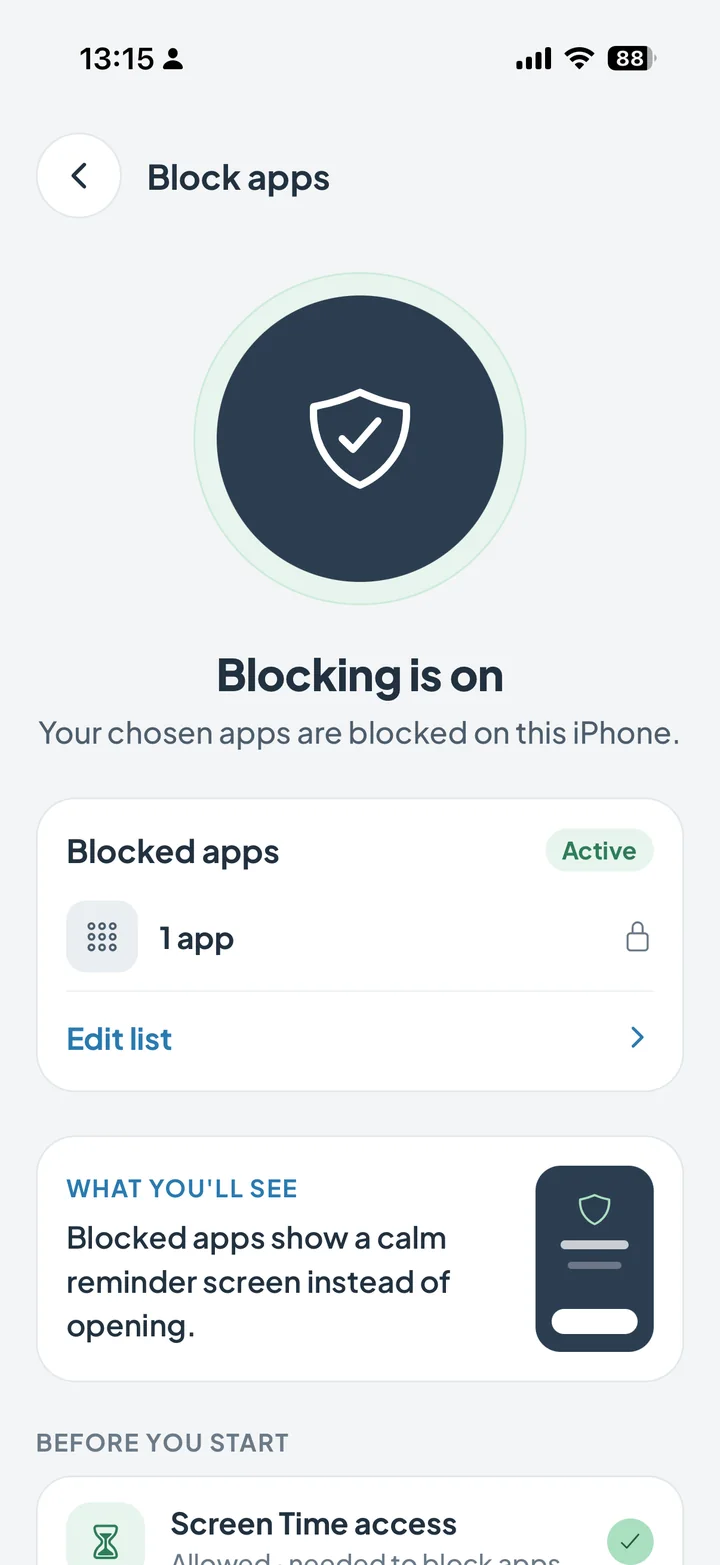
Know its limits: you can switch the blocking off, website blocking works in Safari only, and it doesn't cover a laptop. Set it up while you're calm, and keep the exclusions from steps 1 to 3 in place too.
When an urge hits anyway, the panic button walks you through six steps: a look at what gambling has cost you, 4-4-4 breathing, a reminder of why you're stopping (in your own words if you've written them), rating the urge, a short explainer on how urges work, and a drafted text you can send to someone you trust. The app also tracks your gambling-free streak and estimates the money you keep, based on what you told it you used to spend.
If you've already lost a lot
The pull to win it back is strongest right after a big loss, and a new market every 15 minutes makes chasing very easy. The APA lists chasing losses as one of the signs of gambling disorder. Start with how to stop chasing losses, then list everything you owe and make a plan with the gambling debt payoff plan. If you came from sportsbooks, how to stop sports betting covers the triggers you probably share.
If you feel hopeless, or you're thinking about harming yourself, call or text 988 (US) or call Samaritans on 116 123 (UK). Both are free, any time of day.
Resources & helplines
- US, National Problem Gambling Helpline: call or text 1-800-MY-RESET (1-800-697-3738), 24/7, from the National Council on Problem Gambling.
- Sportsbooks and casinos: your state's self-exclusion program is in our state-by-state list.
- UK: GamCare on 0808 8020 133, free and 24/7.
- Gamblers Anonymous: free meetings in person and online.
FAQ: Kalshi and prediction market addiction
Is Kalshi gambling if it's legal?
Legally, it's contested. In the US, Kalshi and Polymarket's US platform are overseen by the CFTC as financial exchanges, and several states argue that their sports contracts are gambling. The courts haven't settled it yet (checked November 2026). For your health, the label matters less than what it does to you. The National Council on Problem Gambling calls trading event contracts functionally gambling, and the warning signs are the same: chasing losses, needing bigger stakes, hiding it, and failing to stop.
Can you get addicted to prediction markets?
Yes, it can turn into a gambling problem. A counselor quoted by NPR says some clients who excluded themselves from sportsbooks then fell into prediction markets, and the UCLA Gambling Studies Program says it has seen more people come into treatment as these platforms grew. The counselor points to markets that end within minutes and that you can use all day and all night.
Does self-excluding from DraftKings or FanDuel block Kalshi?
No. Sportsbook and state self-exclusion lists cover licensed sportsbooks and casinos. Kalshi doesn't take part in state self-exclusion databases, NPR reported. You need to exclude yourself on Kalshi directly and through SelfExclude.io, and separately on Polymarket and any brokerage app where you trade event contracts.
How do I self-exclude from Kalshi?
Request self-exclusion on kalshi.com or in the Kalshi app, and pick the longest period you can. Close any open positions first, because you can't sell them while you're excluded. Kalshi's voluntary opt-out and personal funding cap sit under Responsible Risk Management in the account menu, and Kalshi says they can't be lifted or changed until they expire. Then add SelfExclude.io for a shared exclusion across the prediction markets that take part.
How do I block Kalshi and Polymarket on my iPhone?
Delete the apps. Then go to Settings, Screen Time, Content & Privacy Restrictions, App Store, Media, Web, & Games, Web Content, choose Limit Adult Websites, and add kalshi.com, polymarket.com and polymarket.us under Never Allow. Those are the iOS 18 and iOS 26 steps, and the menus may differ on iOS 27. Let someone you trust set the Screen Time passcode. NoGambling.app can do much of this with one switch: it blocks the betting apps you pick, Kalshi and Polymarket included, and its US website list includes kalshi.com and polymarket.com in Safari. App blocking needs iOS 16 or later.
Block Kalshi, Polymarket and the sportsbooks. Free to try.
NoGambling.app blocks the betting apps you pick and the most popular gambling sites in your country in Safari, walks you through urges with a 6-step panic button, tracks your streak and estimates the money you keep. Free to try, then monthly, yearly, or a one-time lifetime purchase. No email needed to start.
Download on the App Store → iPhone · iOS 15.1 or later (app blocking needs iOS 16) · Free to try