How to Recover Money Lost to Gambling (Without Chasing It)
Need help now? US: call or text the National Problem Gambling Helpline at 1-800-MY-RESET (1-800-697-3738). UK: GamCare 0808-8020-133. Free, confidential, 24/7.
How to recover money lost gambling — in short
There is no bet, system, or service that wins your losses back — chasing losses is how the hole got this deep. The only guaranteed recovery runs forward: stop the bleed (block the apps, self-exclude, lock down the money), face the numbers and pay debts smallest-first, claim the few refunds that are actually real (and dodge the "funds recovery" scams that aren't), and count every un-gambled dollar as money recovered. Stopping is part of the bigger how to stop gambling system.
If this just happened and you're in crisis right now, read I lost all my money gambling — what to do now first. If the problem is the debt rather than the loss, go to the gambling debt payoff plan.
The hard truth: you can't gamble your way back to even
If you searched how to recover money lost gambling, some part of you is probably hoping for a way to win it back. Here it is straight: that hope is the trap. "One good parlay and I'm even" feels logical because of two forces working on you at once. Sunk cost — the money is gone, but your brain treats it as an investment you can't abandon. And variable reward — the occasional win taught your brain that the next bet might be the one, which is exactly the mechanism slot machines and same-game parlays are built on. Chasing losses is such a predictable pattern that it's listed as a diagnostic sign of gambling disorder.
The math never bends: every game and every betting market is priced so the operator keeps a margin. More play means more expected loss. The only guaranteed way to recover money from gambling is to stop giving gambling your money — everything below builds on that. If the urge to chase is what you're fighting tonight, start here: how to stop chasing losses.
Step 1 — Stop the bleed
Recovery can't start while money is still leaking out. Do these this week, not "someday":
- Block the apps and sites. All of them, not just your main one — there are 15+ licensed sportsbooks a tap away. Brand-specific walkthrough: how to block DraftKings, FanDuel & every other betting app.
- Self-exclude. Every major operator has a self-exclusion option in its responsible-gaming settings, and most US states run a program that covers every licensed operator at once. Treat it as permanent.
- Ask your bank for a gambling block. Most major UK banks and a growing number of US banks and card apps can block gambling-coded transactions on your card for free. One phone call.
- Hand over the friction points. Give your credit cards to someone you trust for a while, remove instant-transfer apps from your phone, and let a partner or friend hold the passcodes. Every second between urge and deposit is a second for the urge to pass.
Step 2 — The honest math (debt snowball)
Avoiding the numbers keeps them scary and keeps you gambling "to fix it." So look, once, all the way:
- List every debt — credit cards, overdrafts, loans, money owed to people. Amount, minimum payment, who it's owed to. One page.
- Keep every minimum current, then throw everything extra at the smallest debt first. When it's gone, roll its payment into the next smallest. That's the snowball method.
- Why smallest-first? Because a debt fully cleared in month one or two is proof the plan works — and for a recovering gambler, quick visible wins are what keep you off the "one bet would fix this faster" ledge. If a debt is at crisis interest rates, a nonprofit credit counselor can help you reorder or consolidate.
If debts are severe, talk to a nonprofit credit counseling agency (in the US, look for NFCC-member agencies; in the UK, StepChange and National Debtline are free). They negotiate with creditors every day and cost nothing — unlike the "debt fixers" who advertise to gamblers.
This is the short version. For the full sequence — including the consolidation trap that catches almost everyone, snowball versus avalanche, and how long this realistically takes — see how to get out of gambling debt: a realistic payoff plan.
Step 3 — Refunds that are real vs. the second scam
This is where honesty matters most, because there's an entire industry waiting to scam you a second time.
What almost never works
Chargebacks against licensed operators. You authorized the deposits, so your bank treats them as valid purchases — losing the bet is not a billing error, and banks generally decline these disputes. Filing a false dispute can get your bank account flagged and your gambling account sent to collections. Don't build your recovery on this.
What is sometimes real
- Unlicensed or offshore operators. If a site wasn't licensed to take your bets in your state or country, disputes and complaints have far more traction. Report it to your state gaming regulator or attorney general (US) and talk to your bank.
- Deposits accepted after you self-excluded. In some jurisdictions, an operator that lets a self-excluded person deposit has breached its obligations. In the UK, operators that took bets from people registered with GAMSTOP have refunded losses after complaints escalated to the regulator or an independent adjudicator. In the US, outcomes vary by state — complain in writing to the operator first, then to your state regulator.
- Serious operator failures. Some jurisdictions (notably the UK) require operators to intervene when a customer shows clear signs of harm; documented failures have led to refunds through formal complaints. These cases are slow, evidence-heavy, and never guaranteed.
In every real case the path is free: written complaint to the operator → escalation to the regulator or an official dispute service → your bank. Keep records of everything.
The second scam: "funds recovery" services
Scammers keep lists of people who've lost money and target them with a cruel pitch: "We can recover your gambling losses — just pay the retainer / processing fee / tax first." That upfront fee is the scam. The FTC and other regulators warn about exactly this pattern. Rules of thumb: legitimate channels (your bank, card issuer, regulator, attorney general) never charge you to pursue your own money; nobody who cold-calls or DMs you about your losses is real; and any "guaranteed recovery" promise is a lie. If it happened to you, report it — and don't let shame stop you from telling someone.
One tax note (US): you can't deduct net gambling losses against regular income — losses only offset reported winnings, and only if you itemize. Talk to a tax professional before counting on anything there.
Step 4 — Rebuild: the money you don't gamble IS the recovery
Here's the reframe that makes the plan stick: every dollar you don't gamble this month is a dollar recovered. Recovery isn't a jackpot event in the future — it's a number that starts moving the right way the day you stop. Make it visible:
- Track the money you keep. Take what you were gambling per week and watch it accumulate instead. Full guide: how to track your gambling savings.
- Automate it. Move that amount to a separate savings account on payday, before the danger window opens.
- Tie it to your streak. A clean-day counter and a money counter rising together is the closest thing recovery has to a dopamine replacement.
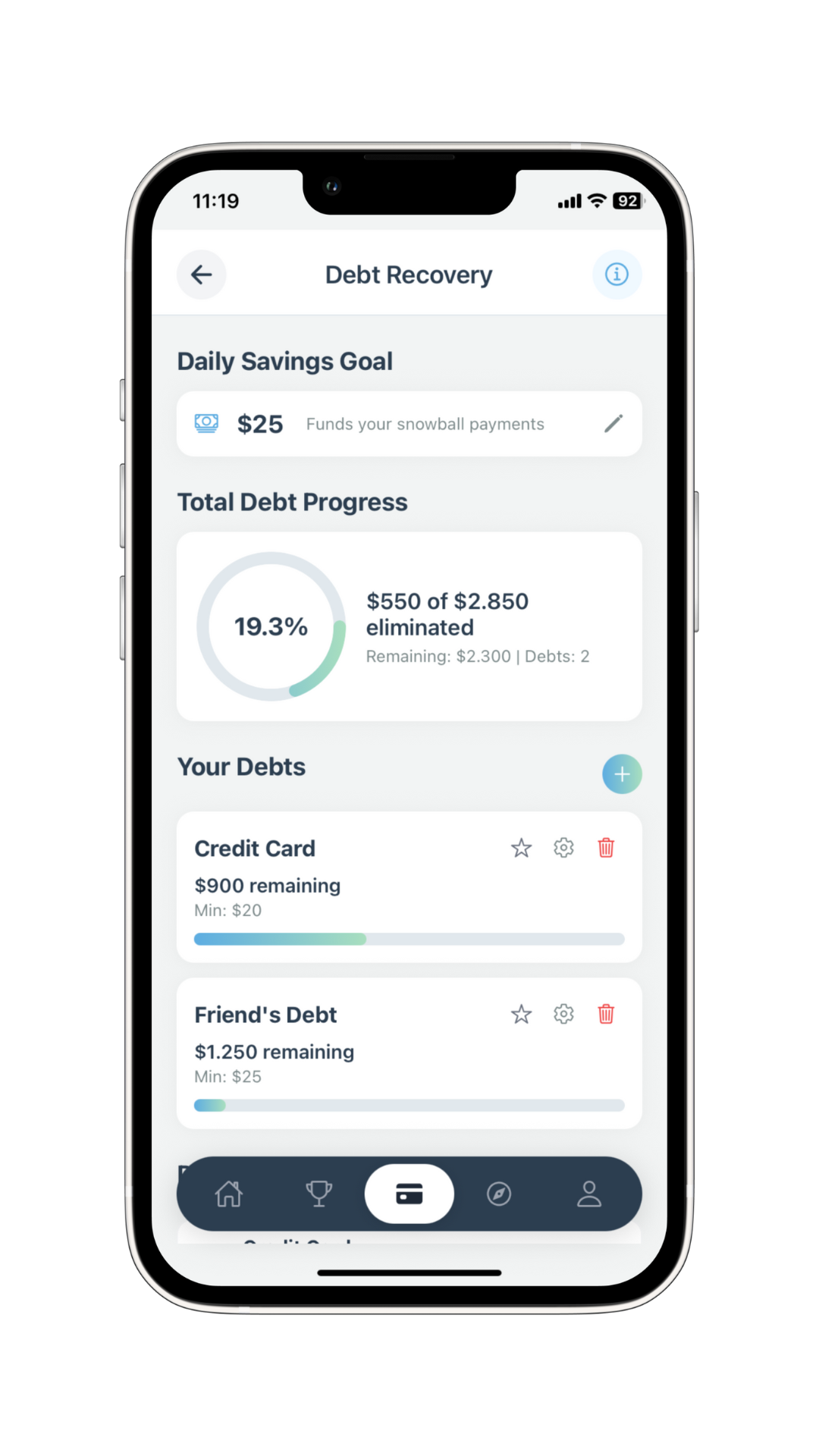
NoGambling.app's savings & debt dashboard does this out of the box: a debt snowball planner that orders your debts smallest-first and shows payoff dates, savings projections based on what you used to gamble, and a real-time streak — because every day the streak grows is a day the money stayed in your account.
What a realistic timeline looks like
No honest guide can promise dates — it depends on how much was lost and what you earn. But the shape is consistent:
- Week 1: blocks and self-exclusion in place, debts listed, bank called. Urges are loud; this is normal.
- Month 1: first full month where the number moved the right way — often the first time in years. Maybe the smallest debt is gone.
- Months 2–6: the snowball rolls; urges get quieter and more predictable; the savings tracker stops being theoretical.
- Year 1 and beyond: the big debts shrink, credit starts healing, and the money you'd have gambled is visibly somewhere else.
Slower than a fantasy parlay win? Yes. But this one only moves in one direction.
Resources & helplines
- US — National Problem Gambling Helpline: call/text 1-800-MY-RESET (1-800-697-3738), 24/7. State self-exclusion programs cover all licensed operators in your state.
- US — money help: nonprofit credit counseling via NFCC-member agencies; report unlicensed sites and recovery scams to your state attorney general and the FTC.
- UK — GamCare 0808-8020-133, plus GAMSTOP (self-exclusion) and free debt help from StepChange or National Debtline.
- Gamblers Anonymous — free meetings in person and online; many groups help members work through the financial wreckage step by step.
FAQ — recovering gambling losses
Can you get back money you lost gambling?
If you gambled with a licensed operator and lost, you generally have no legal claim to the money — the bet was a completed transaction. Narrow exceptions exist: sites operating illegally in your state, and deposits an operator accepted after you had self-excluded (in some jurisdictions). The reliable way to recover is forward: stop gambling, pay down the debt, and rebuild savings from the money you're no longer losing.
Can I do a chargeback on gambling deposits?
Rarely. You authorized the deposits, so banks usually treat them as valid purchases — losing the bet is not a billing error. Chargebacks have more traction when the operator was unlicensed in your jurisdiction or took deposits after you self-excluded. Talk to your bank honestly; never file a false dispute.
Are gambling "funds recovery" services legitimate?
Almost all are scams — a second scam aimed at people who already lost money. They charge an upfront fee (a "retainer", "tax", or "release charge") to recover your losses, then disappear. Regulators like the FTC warn about exactly this pattern. Every legitimate channel — your bank, your card issuer, your state regulator or attorney general — is free. Never pay upfront to get money back.
Should I try to win my gambling losses back?
No. Chasing losses is how the hole got this deep — it's such a reliable pattern that it's listed as a diagnostic sign of gambling disorder. Every game and market is priced so the operator keeps a margin, so more play means more expected loss. The moment you stop trying to win it back is the moment recovery actually starts.
How long does it take to recover financially from gambling losses?
It depends on the size of the debt and your income — for most people it's a matter of months to years, not weeks. But the direction flips on day one: the first bet-free month is the first month the number moves the right way. List every debt, pay the smallest first for momentum, and track the money you keep so you can see the recovery happening.
Watch the money come back — start free
NoGambling.app turns recovery into numbers you can see: a debt snowball dashboard, savings projections from what you used to gamble, and a streak that means money staying in your account. Rated 4.9★. Free 3-day trial, then $7.99/month, $19.99/year, or $39.99 lifetime.
Download on the App Store → iOS 15.1 or later · Free 3-day trial · Lifetime purchase option