How Long Does It Take to Break a Gambling Habit? A Realistic Timeline
Need help now? US: call or text 1-800-MY-RESET (1-800-697-3738) (1-800-426-2537), the National Problem Gambling Helpline — free, confidential, 24/7. UK: GamCare 0808-8020-133.
How long to break a gambling habit — in short
There's no magic number, and the famous "21 days" is a myth. When researchers actually measured habit formation, new behaviors took anywhere from 18 to 254 days to become automatic — a median of about 66. But here's the good news the averages hide: each urge passes in minutes, urges typically get rarer within weeks, and most people feel meaningfully more in control by day 90. You don't wait to feel strong before starting — you build the system on day 1 and let the days stack.
The 21-day myth (and where it actually came from)
The "21 days to break a habit" claim doesn't come from habit research at all. It traces back to a plastic surgeon in the 1960s who observed that patients took about three weeks to get used to their new appearance — an observation about self-image that got repeated until it became a "law." When researchers at University College London actually tracked people forming new daily habits, automaticity took anywhere from 18 to 254 days, with a median around 66 — roughly two to eight-plus months, varying hugely from person to person.
Why does this matter to you? Because if you plan around "21 days," day 22 feels like proof you're broken. You're not broken — the deadline was fake. Gambling is also not a neutral habit like drinking more water: it's a behavior reinforced by unpredictable rewards, which makes the pull more persistent. Expect months of rewiring, not weeks — and expect to feel much better long before the rewiring is finished.
Two clocks: the urge clock and the habit clock
"How long does it take?" is really two questions. The urge clock is short: a single urge typically crests and passes within minutes if you don't act on it — that's the window a panic button covers. The habit clock is long: months for "not gambling" to become your default. People relapse when they confuse the clocks — they win a 5-minute urge battle, feel like the war should be over, and get demoralized when another urge lands on day 40. Both clocks are running. Both end in your favor.
Days 1–7: the hardest week (urges frequent, but short)
The first week is honestly the hardest. Urges can land daily or hourly, your evenings suddenly have holes where gambling used to be, and many people feel restless, irritable, or low — that discomfort is so common it appears in the diagnostic criteria for gambling disorder. None of it means quitting isn't working; it means it is.
What matters this week is not elegance — it's survival with structure: gambling apps blocked, money friction in place, and a plan for the urge moment (here's exactly what to do when you feel like gambling). This is also why NoGambling.app's streak tracker counts every second, not just days: in week one, "day 2" can feel pathetic, but "38 hours, 14 minutes" is a number that visibly grows every time you look at it — and that you won't want to reset.
Day 30: routines are forming
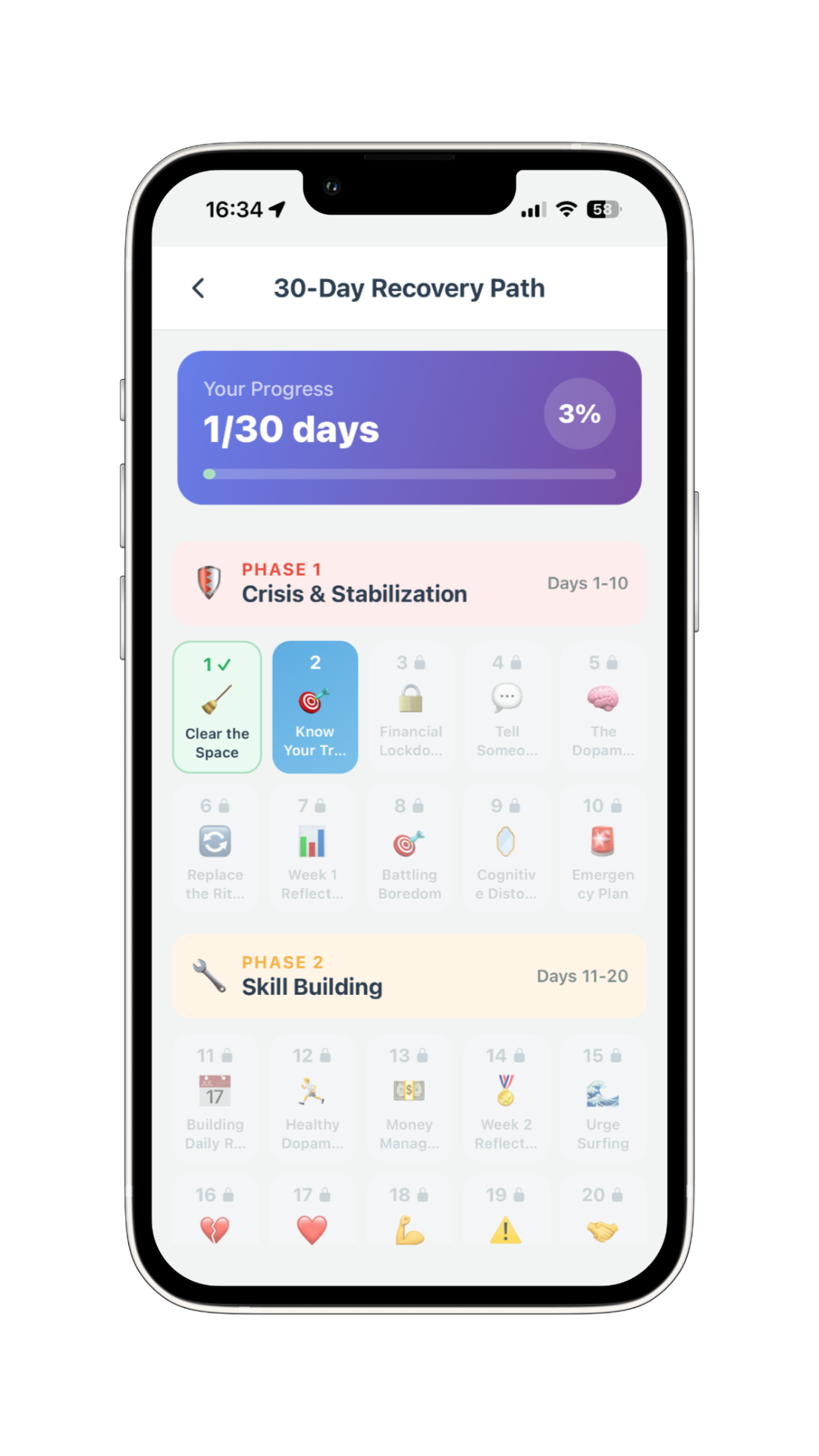
By a month in, the panic phase has usually eased. Urges still come, but less often, and you can feel new routines taking shape — mornings that don't start with a betting app, paydays that don't vanish. This is the window where structure pays off most, and it's exactly why the app's 30-day challenge unlocks one day at a time: not 30 tasks to binge on a motivated Sunday, but one small daily action — matching how habits are actually built, one repetition per day. A solid start-of-day anchor helps too: the stop-gambling morning ritual.
One warning about day 30: confidence is the classic trap. "I've got this now — I could handle one bet" is a day-30 thought, and it has ended more streaks than any losing night. The habit clock is still running; keep the blocks on.
Day 90: the widely used marker
Ninety days is a milestone used across recovery programs, and for good reason: it's long enough for new routines to have had months of repetition, and by now urges are usually rare, short, and predictable — tied to specific triggers like payday, game day, or stress rather than ambient and constant. Knowing your personal pattern is what carries you from here; if you haven't mapped it yet, start with gambling relapse triggers.
Day 90 is also when the money story turns visible. Three months of not gambling is often the first time in years that debt has moved down and savings up for a full quarter — the app's debt snowball dashboard and savings tracker turn that into a number you can watch. How to set it up: how to track your gambling savings.
Day 365: the identity shift
A year in, something quieter has happened: you've stopped being someone who is white-knuckling not-gambling and become someone who doesn't gamble. You've been through every payday, every season of your sport, every holiday and birthday — once each, without betting. Urges may still visit occasionally, and a bad day can still whisper; but the default has flipped, and that's what "breaking the habit" actually means.
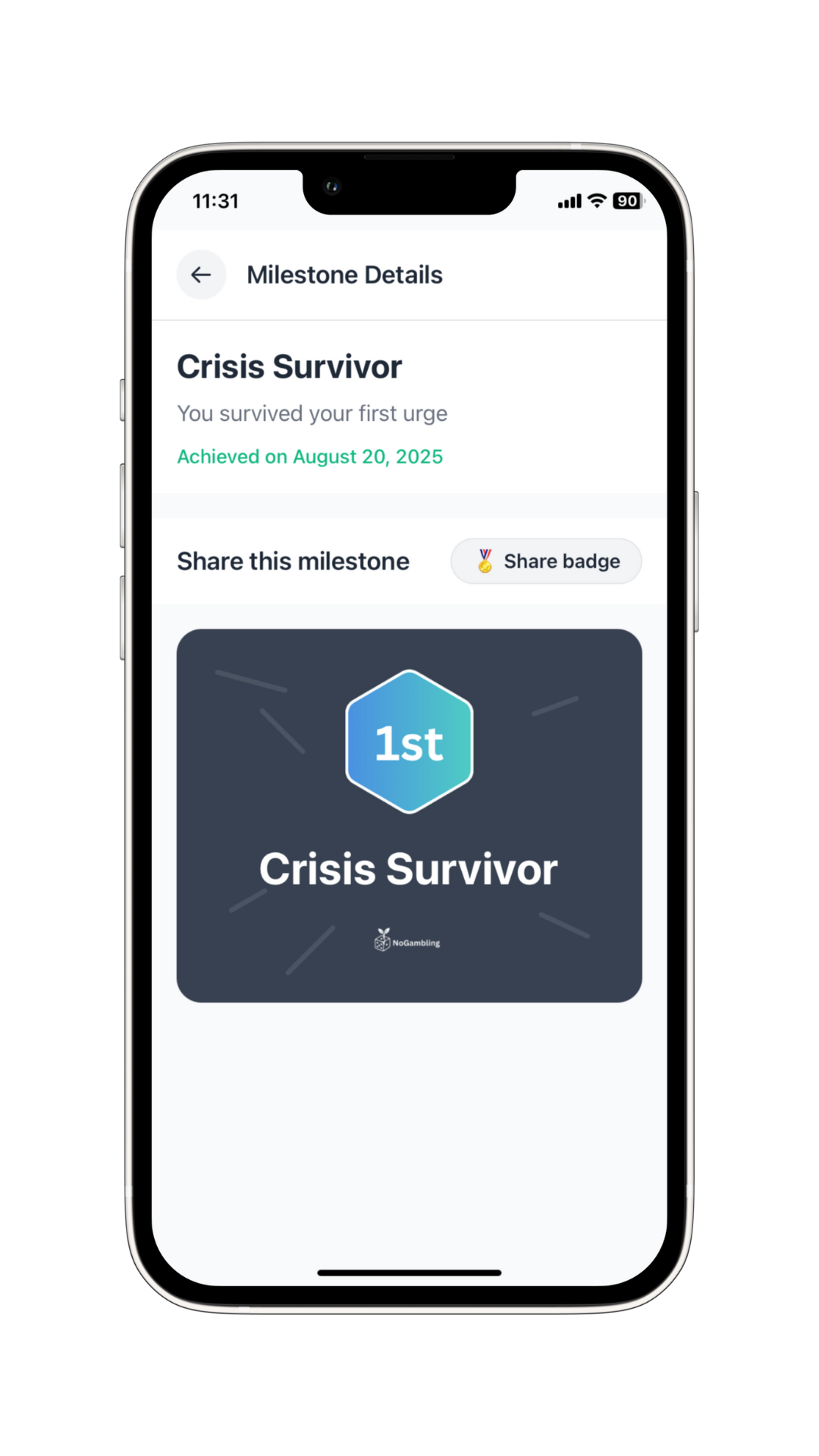
This is what the app's milestones and badges are for — not decoration, but a record. Each badge marks a stretch of days that used to feel impossible, and on a hard day a year from now, that progress timeline is the evidence you argue back with.
How to make day 1 stick
The timeline above only starts when day 1 holds — and day 1 holds when it doesn't depend on willpower. Block the gambling apps at the device level, add friction to your money, set up the panic button before the first urge, and make a one-day promise instead of a forever promise. The complete setup is here: how to stop gambling — the step-by-step system. And if you're reading this mid-crisis rather than planning ahead, start here instead: I can't stop gambling — what to do tonight.
Resources & helplines
- US — National Problem Gambling Helpline: call or text 1-800-MY-RESET (1-800-697-3738), 24/7, free and confidential. Chat at ncpgambling.org/chat.
- UK — GamCare: 0808-8020-133, plus the GamStop register that blocks every UK-licensed gambling site at once.
- Gamblers Anonymous — free meetings in person and online; hearing "it got easier for me around month three" from a real person is worth more than any timeline article.
FAQ — timelines for quitting gambling
How many days does it take to break a gambling habit?
There is no fixed number. Habit-formation research (a University College London study tracking new daily habits) found automaticity took anywhere from 18 to 254 days, with a median around 66 — roughly 2 to 8+ months. But you don't need full rewiring to feel better: individual urges pass in minutes, urge frequency typically drops over the first weeks, and most people feel meaningfully more in control by around 90 days.
Is the 21-day habit rule real?
No. The 21-day figure traces back to a 1960s plastic surgeon's observation about patients adjusting to their new appearance — not to habit research. When researchers actually measured habit formation, the median was about 66 days with a huge range between people. Planning your recovery around 21 days sets you up to feel broken on day 22 for no reason.
How long do gambling urges last?
Two different clocks: a single urge typically crests and passes within minutes (often 3–10) if you don't act on it, though early urges can take longer to fully fade. The season of frequent urges is longer — usually most intense in the first days and weeks, then urges become rarer, shorter, and more tied to specific triggers like payday or game day.
Does a relapse reset my progress to zero?
The streak counter resets; the progress doesn't. Everything you built — weaker urge pathways, trigger awareness, blocking, support, money safeguards — is still there on the morning after a lapse. The dangerous part of relapse isn't the bet, it's the "I've ruined everything, might as well keep going" story. Treat a lapse as data, restart the counter, and the next stretch is usually longer.
Are there withdrawal symptoms when you stop gambling?
Many people feel restless, irritable, low, or foggy in the first days and weeks — restlessness and irritability when cutting back are so common they appear in the diagnostic criteria for gambling disorder. It is uncomfortable but temporary, and it is a sign your brain is recalibrating, not a sign quitting isn't working. If low mood is severe or you have thoughts of self-harm, talk to a professional or call 988 (US).
Why is 90 days such a big milestone?
Ninety days is a widely used marker across recovery programs — long enough that new routines have had months to bed in, urges have usually become rare and predictable, and you've survived at least one full cycle of paydays, weekends, and big games. It isn't a finish line, but for many people it's the point where not gambling stops being a daily fight and starts being how life works.
Start day 1 — and watch the days stack
NoGambling.app counts every clean second, unlocks the 30-day challenge one day at a time, and marks every milestone on your timeline. Free trial, then monthly / yearly / lifetime. iOS, offline-first, anonymous.
Download on the App Store → iOS 15.1 or later · Free trial · Lifetime purchase option