What to Do When You Feel Like Gambling (Right Now)
Need a human right now? US: call or text 1-800-MY-RESET (1-800-697-3738) — free, confidential, 24/7. UK: GamCare 0808-8020-133.
Feel like gambling? Do this — in short
The urge you're feeling right now is a wave, and urges like this eventually pass. How long varies: in one small study, cravings lasted about 37 minutes on average, and some lasted hours. So you don't have to resist forever, only get through this stretch without betting. Put 60 seconds between you and the bet, breathe 4-4-4, rate the urge, look at your real numbers, move, tell someone, and delay with a 30-minute timer. This page is what to do in the moment. For how the app's version works, see how the 6-step panic button works.
One thing before the list: you don't need to feel motivated, strong, or "recovered" to try any of this. Every item below just buys time while the urge has a chance to fade.
10 things to do instead, in the order to try them
1. Put 60 seconds between you and the bet
Right now, before anything else: lock your phone, put it in another room, or hand it to someone. Don't decide anything about gambling forever — just make the next bet take 60 seconds longer to reach. A minute of friction gives you room to pick the next step on this list.
2. Breathe 4-4-4
In for 4 seconds, hold for 4, out for 4 — three full rounds. The NHS suggests slow breathing for stress, anxiety and panic, and a review of 15 studies in healthy people linked it to more relaxation and less anxiety. None of that was about gambling urges, so treat it as a way to get steady enough for the next step. This is the same breathing the panic button paces you through.
3. Rate the urge 1–10 and name the trigger
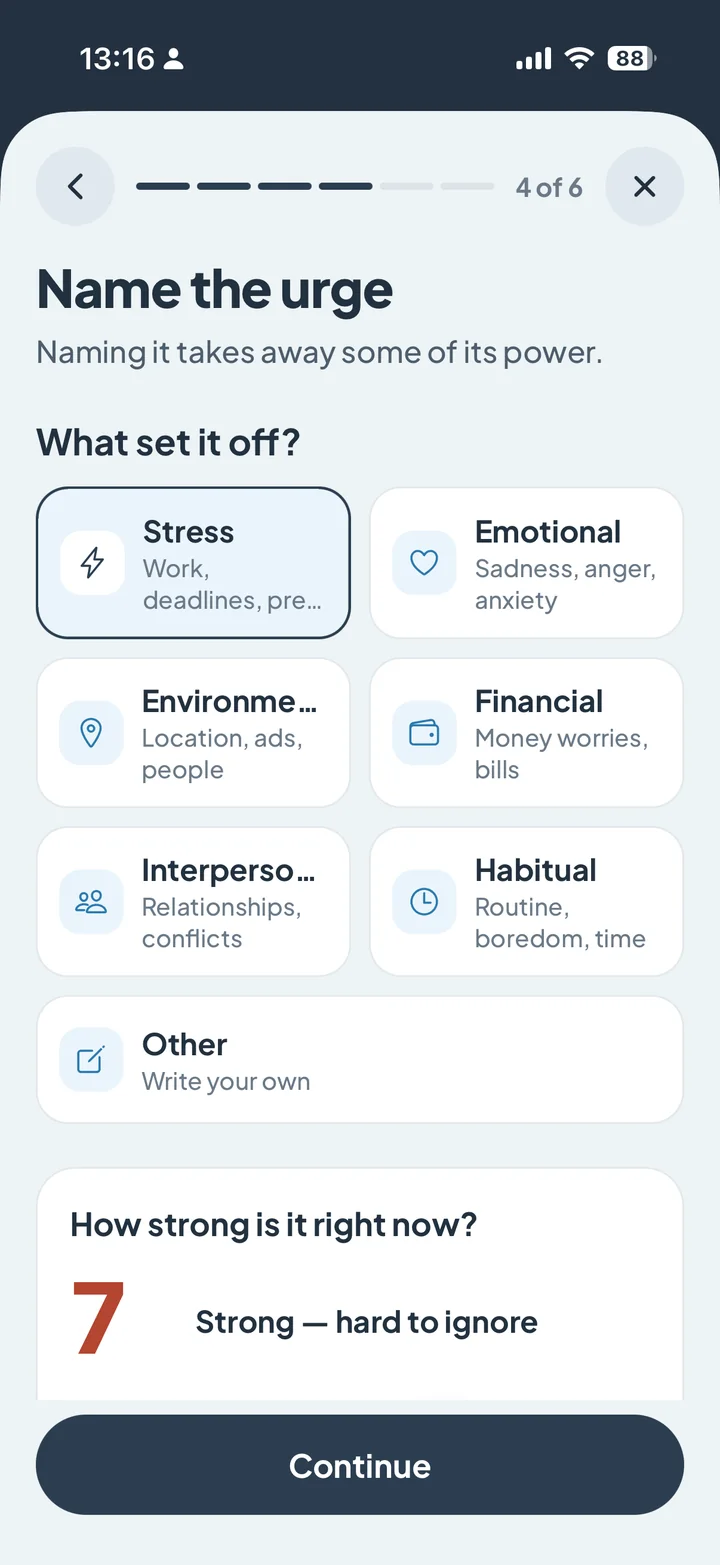
Ask yourself: how strong is this, and what set it off — stress, boredom, payday, an ad, an argument? In a brain imaging study, putting feelings into words reduced the amygdala's response to upsetting pictures. That wasn't a gambling study, but naming an urge is a quick way to step back from it. Writing urges down also shows you your patterns, which helps you plan around your relapse triggers.
4. Look at the real number gambling has cost you
The urge is selling a fantasy: this bet is the one that fixes it. Fantasies are abstract; kill them with a specific number. Open your loss total, your debt figure, or the savings you've built since quitting — whatever number is real for you. You cannot hold "one win fixes everything" in your head next to what gambling has actually cost you.
5. Move your body or leave the room
Stand up, walk out the door, do 20 push-ups, take a shower. Anything that takes your mind off gambling and gets the phone out of your hand helps you wait. Gambling Help Queensland suggests the same: do something to take your mind off it.
6. Text someone, or reach out another way
Telling someone means you aren't alone with it. Text one person "urge just hit, talk me through the next ten minutes." If nobody in your life knows yet, call or text the helpline at the top of this page, or post in NoGambling.app's community. Posting there needs an email, and your username is made from the first part of that email, so it isn't automatically anonymous. You don't need advice. You just need someone to know until it passes.
7. Delay with a timer: "if I still want to in 30 minutes"
Tell yourself not yet. Gambling Help Queensland suggests trying to wait at least half an hour, so set a 30-minute timer. In one small study, people rated "delay and distract" as the most helpful tip in the urge app they tested. If you still want to bet when it rings, set it again or call the helpline. Urges can last longer than one timer.
8. Do the math on the odds
While the timer runs, get cold about it: every game you're offered has a built-in house edge — that's how the operator pays for the ads, the app, and the bonuses. Played long enough, the expected result is a loss, which is why the NHS says not to see gambling as a way to make money. The urge says tonight is different. The math says nothing about tonight is different.
9. Open your streak instead of the sportsbook
Muscle memory wants you to open an app — so open a different one. Your streak tracker shows the days, hours, and seconds you've stayed gambling-free, ticking up in real time. Look at that for a minute instead of the odds, and ask yourself whether you want to take it back to zero.
10. If urges keep winning — block everything
If urges keep winning, make gambling harder to reach. Block gambling apps and sites at the device level, delete the payment shortcuts, and consider self-exclusion. In Great Britain, GamStop covers online gambling companies licensed there. In the US, ask the helpline what your state offers. NoGambling.app can block the betting apps you pick through Apple Screen Time (iOS 16 or later) and the most popular gambling sites in your country in Safari. You can switch that off, so use it alongside the rest. The full plan (money safeguards, triggers, tracking) is in how to stop gambling.
When the urge passes — one more minute
When the wave breaks — and it will — do one thing before you move on: note what triggered it and what worked. Ten seconds of logging turns tonight's near-miss into next week's early warning. If you did gamble, you can still stop tonight: here is what to do after a relapse. And if urges like this are landing every day and winning often, that's not a willpower problem, it's a signal — start here: I can't stop gambling — what to do tonight.
Resources & helplines
- US — National Problem Gambling Helpline: call or text 1-800-MY-RESET (1-800-697-3738), 24/7, free and confidential. Chat at ncpgambling.org/chat.
- UK — GamCare: 0808-8020-133, plus GamStop, the free scheme that stops you using gambling sites and apps from companies licensed in Great Britain.
- Gamblers Anonymous — free meetings in person and online, with people who know what this is like.
FAQ — gambling urges in the moment
How long does the urge to gamble last?
It varies. In one small Australian study, cravings lasted about 37 minutes on average, and some lasted hours, so don't judge yourself if yours takes longer. Gambling Help Queensland says urges come in waves and eventually pass, and suggests waiting at least half an hour before you decide anything. Stay away from betting apps, odds-checking, and "just looking" while you wait.
How do I distract myself from gambling?
Pick distractions that change your body or your location, not just your screen: leave the room, walk, do push-ups, take a shower, call someone. Scrolling on the same phone that has the sportsbook one tap away is weak distraction. The best options add friction and time between you and the bet — that is what lets the urge pass.
What can I do instead of gambling?
In the urge moment: breathe 4-4-4, rate the urge 1-10, look at what gambling has actually cost you, move your body, text someone or call a helpline, and set a 30-minute timer before any decision. Longer term, replace the role gambling played (excitement, escape, money hope) with things that scratch the same itch: sport, gym, a savings goal you can watch grow, a community.
What triggers the urge to gamble?
Common triggers include stress, boredom, loneliness, payday or sudden cash, game day, arguments, alcohol, and gambling ads. Urges can also come out of the blue. If you log each one (time, trigger, intensity), you may start to see a personal pattern, and an urge you saw coming is easier to plan for.
Should I just delete my betting apps?
Delete them, yes, but deleting alone isn't enough, because you can reinstall in seconds mid-urge. Pair deletion with device-level blocking (iOS Screen Time plus a dedicated blocker), and consider self-exclusion. In Great Britain, GamStop covers online gambling companies licensed there. In the US, ask the helpline what your state offers. Friction you set up on a calm day is what protects you on a bad one.
Put the panic button one tap away
NoGambling.app's panic button takes you through six short steps, including 4-4-4 breathing, your own numbers, and naming the urge. Free to try, then monthly / yearly / lifetime. iOS, no email needed to start.
Download on the App Store → iOS 15.1 or later · Free to try · Lifetime purchase option